Tuesday, October 11, 2016

Human Variation and Race 


Cold 

1.In past chapters we have discussed that early hominins evolved from Africa, the warm-to-hot woodlands and savannas of East Africa. This plays a against humans survival in cold weather because we come from ancestors that were adapted to heat , so the body had to adapt to this weather making the body due more work with populations living in cold weather. Living in cold weather requires the body to create more energy because the body needs to either retain heat and/or increase the heat production.For the body to produce more energy it requires a good diet, which during the winter can be a problem because the food in not as abundant, due to cold weather not as many food like fruits and vegetables grow. 


2.Humans have adapted to this stress in different adaptions: 


  • Short -term adaptation 
A short-term adaptation to cold is shivering. shivering generates muscle heat. When the body is exposed to col weather the body temperature drops and in response the body shivers to help maintain homeostasis. The shivering helps the body to raise its temperature. 
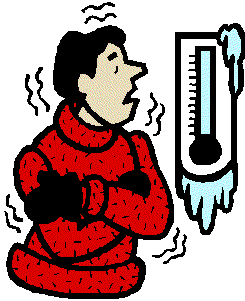
Image result for shivering
Another short-term response is the metabolic rate, where the cells break up nutrients into their components and release energy in the from of heat. The body wants to conserve energy and heat and for that reason in cold environments our metabolism is slower. 

Image result for metabolic rate

  • Facultative adaptation
Facultative adaptation involves turning on and off genes that alter phenotypic expressions in response to an environmental stress. In the case of cold weather vasoconstriction is the facultative adaptation because is an involuntary response to cold that depend on the skins surface. Vasoconstriction restricts capillary blood flow to the surface of the skin and this reduces the loss of heat at the body surface. 

Image result for Vasoconstriction


  • Developmental adaptation 
Developmental adaptation are traits that we are born with and once they are expressed we will live with hem for the rest o four life. A great example of developmental adaptation is the rule of Bregmann, where he states that animals with larger bodies are generally more massive and produce more body heat. Our ancestors relied on their subcutaneous fat layer as protection for cold weather but also as a type of back up source when food was scarce. 
Image result for bergmann rule


  • Cultural adaptation: 
The Inuit are people living in the Artic,they had a carnivorous diet because of their hhigh animal protein and fat diet.  Due to the environment in which they lived, they didn't have access to fruit and vegetables, so they based their diet on what was available to them. The fat they gained from the animal consumption provided them the energy and carbohydrates they needed to be able to survive in the cold. 
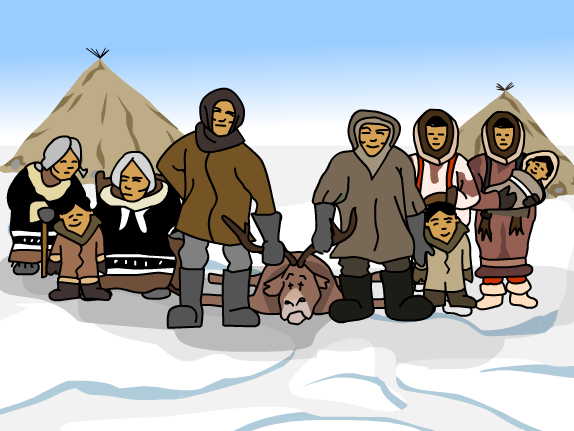
Image result for inuit


3. The benefit from studying human variation is that we learn how and why different people from different places acquire different customs and ways of living. We are able to understand that we are all the  same but  have to look for different ways to survive in the different environments the world offers, nobody is special in any way we are all the same and some of our features are there, the way we look is sometimes related to a survival trait. 


4. The use of race helps understand the variation of adaptations because people from different places adopt different customs and and different phenotypic traits that help them survive in the environment they are born in, and this different customs an traits is what makes race. The study of environmental influences on adaptations is a better way to understand human variation than by the use of race because race is a main focus on to classify people into groups that depend on skin color, common language and ancestors and this could lead to racism, on the other hand the environmental influences on adaptations explain the reasons and the way people are different from each other, how and why they got to that point , making it clear that we are equal and the way we look and behave is related to a way of surviving. 

Tuesday, October 4, 2016


There are two parts to this blog post, they are base on two different experiments on one of them I was asked to have a conversation without speaking, and on the second experiment I was asked to engage in a conversation where i could not have any body language nor facial expressions.

On the first experiment I engaged in a conversation for 15 minutes where I was not allowed to use any version of a symbolic language (no speaking, writing, or ASL). I did this experiment with my best friend; not being able to talk when she was asking me questions was funny and a little frustrating when I was trying to respond to her and she will interpret what I was trying to say in a different way. For example trying to mimic the word “save”, ad she will tell me “put”, “shove”, “slide”, until I found a way to do it, I made my nose look like that of a pig and got a dollar and pretended to save it in my had, that’s how I got her to understand what I was trying to tell her. 

 My friend altered the way she was talking to me in a way that she was guessing what I was trying to mimic or her and the way the conversation was going as not as it usually does, it was random stuff, with easy questions to answer.
In this experiment my friend was completely in control of the conversation I was only responding to her questions the best I could and she was trying to guess my answers. I only did this with one friend but even though it felt like sometimes she was just talking to herself because I couldn’t give her that much feedback. In this conversation I think my partner had the power of the conversation because I will respond to whatever topic she was talking about because I was unable to start a new conversation, I was more like a follower.


In my opinion in a culture that uses spoken language and the other one that doesn’t they would both be able to communicate complex ideas just in different ways. The speaking culture has the advantage of using fancier words, and the other culture without spoken language would just have to mimic their ideas or feelings. The speaking language culture might think that the culture that does not use symbolic language are dumb and that are unable to understand,  they might also make them feel less because they might feel superior than them. A modern situation that resembles the relationship between a culture that can speak and a culture that can’t is the current Hearing Culture and Deaf Culture,  back then deaf people were sadly called “dumb” because they were unable  to speak , now the deaf people have made their own language and culture.

On the second experiment I was asked to spend 15 minutes communicating without any physical embellishments, no facial expressions or body language, no raising the eyebrows or my voice. This was the most difficult part for me because I kept cracking up and we had to start all over again, I think the first three times I only lasted seven seconds without laughing, and having a conversation with a poker face on was really hard for me, I am used to a lot of facial expression and pointing. I felt like a person with no emotions, almost like a robot. In one part of the conversation my friend was asking me about something work related and I because e of the way I responded she was confused if that’s the way I really felt about the situation or it was just because I wasn’t using any body language nor facial expressions.


This second experiment showed me the importance and how crucial our body language and facial expressions are when we are trying to communicate with each other, they play a big role on the message we are trying to get across. It thought me how the things we say connect to the way our bodies move and react, and that what we say can be misunderstood if we give a different facial expression or body language, for example if we say we are tired and sad while jumping up and down smiling, the visual information we give does not connect to the verbal information we are giving to others. 

The benefit of having the ability to read people’s body language is that we are able to identify things like their mood, if they are happy, sad, tired, sleepy, excited, sad etc. Those are all things that we shoe through our body language and facial expressions; they are really hard to hide them. The ability to read body language is crucial to help a person to obtain resources, survive and reproduce successfully. A person that knows how to read body language is more likely to survive when looking for resources because, for example, if they are in a place where they need to look for food and there are other animals but the person is not sure if the animal is dangerous or not, their understanding of the animal’s body language will help decide to either wall away or get closer to the animal. When reproducing , body language is everything, for example if you go to a party and you like someone but you are not sure if they like you, their body language and facial expressions will give you an idea, if they get nervous or hands are shaking, avoid or make eye contact, etc, those are all tips that will make it or break it.

 I think that there are some people that misinterpret body language, but I think that blind people don’t really get to read much of body language. I believe that body language is sometimes it is convenient to not read someone’s body language because we might misinterpret their body language and that can create problems. An example of this is if there is someone we don’t like and we use their body language to create a concept about them, then we are interpreting their body language in an already set mind that they are bad so everything they do we will interpret as wrong.