Human Variation and Race
Cold
1.In past chapters we have discussed that early hominins evolved from Africa, the warm-to-hot woodlands and savannas of East Africa. This plays a against humans survival in cold weather because we come from ancestors that were adapted to heat , so the body had to adapt to this weather making the body due more work with populations living in cold weather. Living in cold weather requires the body to create more energy because the body needs to either retain heat and/or increase the heat production.For the body to produce more energy it requires a good diet, which during the winter can be a problem because the food in not as abundant, due to cold weather not as many food like fruits and vegetables grow.
2.Humans have adapted to this stress in different adaptions:
- Short -term adaptation
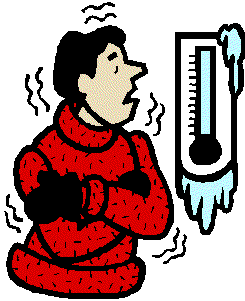
A short-term adaptation to cold is shivering. shivering generates muscle heat. When the body is exposed to col weather the body temperature drops and in response the body shivers to help maintain homeostasis. The shivering helps the body to raise its temperature.
Another short-term response is the metabolic rate, where the cells break up nutrients into their components and release energy in the from of heat. The body wants to conserve energy and heat and for that reason in cold environments our metabolism is slower.

- Facultative adaptation
Facultative adaptation involves turning on and off genes that alter phenotypic expressions in response to an environmental stress. In the case of cold weather vasoconstriction is the facultative adaptation because is an involuntary response to cold that depend on the skins surface. Vasoconstriction restricts capillary blood flow to the surface of the skin and this reduces the loss of heat at the body surface.

- Developmental adaptation
Developmental adaptation are traits that we are born with and once they are expressed we will live with hem for the rest o four life. A great example of developmental adaptation is the rule of Bregmann, where he states that animals with larger bodies are generally more massive and produce more body heat. Our ancestors relied on their subcutaneous fat layer as protection for cold weather but also as a type of back up source when food was scarce.

- Cultural adaptation:
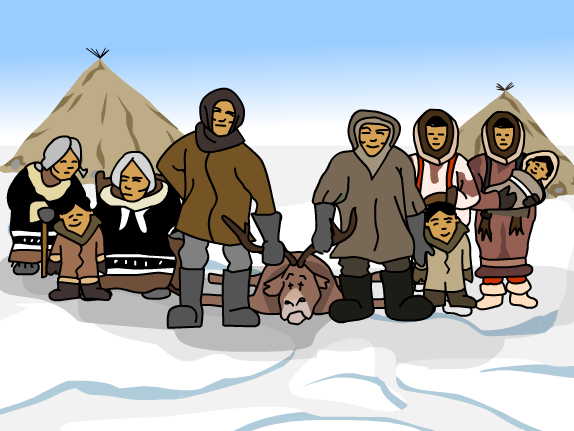
The Inuit are people living in the Artic,they had a carnivorous diet because of their hhigh animal protein and fat diet. Due to the environment in which they lived, they didn't have access to fruit and vegetables, so they based their diet on what was available to them. The fat they gained from the animal consumption provided them the energy and carbohydrates they needed to be able to survive in the cold.
3. The benefit from studying human variation is that we learn how and why different people from different places acquire different customs and ways of living. We are able to understand that we are all the same but have to look for different ways to survive in the different environments the world offers, nobody is special in any way we are all the same and some of our features are there, the way we look is sometimes related to a survival trait.
4. The use of race helps understand the variation of adaptations because people from different places adopt different customs and and different phenotypic traits that help them survive in the environment they are born in, and this different customs an traits is what makes race. The study of environmental influences on adaptations is a better way to understand human
variation than by the use of race because race is a main focus on to classify people into groups that depend on skin color, common language and ancestors and this could lead to racism, on the other hand the environmental influences on adaptations explain the reasons and the way people are different from each other, how and why they got to that point , making it clear that we are equal and the way we look and behave is related to a way of surviving.

Good images.
ReplyDeleteWhile I agree that one problem arising from cold stress is the need to produce more energy, but this is a secondary problem. The reason more energy needs to be produced is to help prevent the body temperature from dropping below the optimum core body temperature of 98.6 degrees. What happens if the body temperature drops below this level? Why is that a problem? This is what needs to be addressed here.
Yes, shivering is a short term response. Increasing the metabolic rates takes time and some type of genetic response, turning on/off genes to increase metabolism. This describes a facultative response, not a short term adaptation.
Good description of your facultative trait.
Bergmann's (and Allen's) rules don't just address the production of heat but also the retention of heat in the body. Round body shapes have less surface area per unit mass than do long, lean body shapes. Less surface area reduces the opportunity to lose heat through the skin's surface.
Good cultural trait.
I agree that knowledge is always useful, but can you identify a way this knowledge can be useful in a concrete way? Can knowledge on adaptations to cold climates have medical implications? Help us develop clothing that retains heat more efficiently? Can we develop new means of home/building construction that might help increase heat retention? How can we actually use this information in an applied fashion?
"...the use of race because race is a main focus on to classify people into groups that depend on skin color, common language and ancestors..."
Well, yes on skin color, but not on language or ancestors. Race is a very superficial social construct, serving only to categorize humans by their external phenotypes alone. As a social construct, it is subject to bias of the culture that creates it. It is not an objective means of explaining human variation. It is only a subjective means of organizing variation, which is not nearly so useful and has no explanatory power whatsoever.
Hi there! What is the direct harm of the body dropping in temperature, what would happen if our bodies didn't create more energy in cold climates? I did heat, so it is interesting to see the differences in how the body reacts. Shaking versus sweating, etc.
ReplyDelete